

Monday, April 25, 2011


Monday, April 18, 2011
Ready to Graduate? Or Ready to Work?
Ready to Graduate? Or Ready to Work?
What is the responsibility of a college to its students? This is one of the key questions lying behind the current discussion about whether college graduates should be getting a job in the area they study. I believe that colleges and universities should be accountable for achieving standards of learning for their graduates that are verifiable through third party standards and review. But to take the next step and say that the school has failed if the graduates do not work in the field for which they were prepared ignores the dynamics of today’s workplace and workforce as well as common sense. It also bypasses the core issue of quality.
I know three people between the ages of 30 and 40. One has a BA in Writing. He’s an emergency room doctor. Another has an American Studies Degree. He is a trained lawyer doing education policy work. The third has a philosophy degree. He is in communications as a governor’s press secretary. I have Master’s in teaching and never taught a day. Did our colleges fail us? Or did they actually prepare us for the dynamics of life in the late 20th and early 21st centuries?
What the current employment discussion misses is the quality dimension. Rather than worrying solely about degree completion, we should worry about the learner’s attainment of the skills and knowledge that we say the curriculum is teaching. No one can control what the economy or what another person actually does. We can, however, control whether the attainment level that we have assigned to the completed course of studies, has been met by the learners who complete. And we can control for whether that attainment level connects accurately with the actual requirements of the careers that fall within their scope.
This can be achieved using course-level learning outcomes that connect to the program outcomes on the academic side inside a college. And we can connect outcomes as capacities needed to meet the requirements defined by employers as necessary for success upon entering the workplace in specific professions at specific levels. For one example, see the Work Keys program at ACT. And we can do the same for the intellectual and content areas generally related to general education as well. Then, the academic and the employment hierarchies can be connected to create a matrix that connects college learning with workplace readiness and benchmarks both.
For those who say the employment discussion won’t touch their institutions, I disagree. People – parents and policy-makers as well as publicly elected officials - are going to want to know how good the learning achievements are for how many learners when compared to externally benchmarked standards. In other words, they will want to know what they are getting for their time and money. In this emerging world, the institution that can give clear and transparent answers to those questions; those colleges that can show that they have the right standards and they meet them with a majority of their learners, will have the respect of the society. Those that will not or cannot will not, over time, sustain that respect.
Attainment, with completion, defined by outcomes tied to external standards and verified by valid, reliable and consistent assessment, are the keys to this future. Then our graduates won’t just be ready to graduate, they will be ready to join the workforce and the civil society.
What is the responsibility of a college to its students? This is one of the key questions lying behind the current discussion about whether college graduates should be getting a job in the area they study. I believe that colleges and universities should be accountable for achieving standards of learning for their graduates that are verifiable through third party standards and review. But to take the next step and say that the school has failed if the graduates do not work in the field for which they were prepared ignores the dynamics of today’s workplace and workforce as well as common sense. It also bypasses the core issue of quality.
I know three people between the ages of 30 and 40. One has a BA in Writing. He’s an emergency room doctor. Another has an American Studies Degree. He is a trained lawyer doing education policy work. The third has a philosophy degree. He is in communications as a governor’s press secretary. I have Master’s in teaching and never taught a day. Did our colleges fail us? Or did they actually prepare us for the dynamics of life in the late 20th and early 21st centuries?
What the current employment discussion misses is the quality dimension. Rather than worrying solely about degree completion, we should worry about the learner’s attainment of the skills and knowledge that we say the curriculum is teaching. No one can control what the economy or what another person actually does. We can, however, control whether the attainment level that we have assigned to the completed course of studies, has been met by the learners who complete. And we can control for whether that attainment level connects accurately with the actual requirements of the careers that fall within their scope.
This can be achieved using course-level learning outcomes that connect to the program outcomes on the academic side inside a college. And we can connect outcomes as capacities needed to meet the requirements defined by employers as necessary for success upon entering the workplace in specific professions at specific levels. For one example, see the Work Keys program at ACT. And we can do the same for the intellectual and content areas generally related to general education as well. Then, the academic and the employment hierarchies can be connected to create a matrix that connects college learning with workplace readiness and benchmarks both.
For those who say the employment discussion won’t touch their institutions, I disagree. People – parents and policy-makers as well as publicly elected officials - are going to want to know how good the learning achievements are for how many learners when compared to externally benchmarked standards. In other words, they will want to know what they are getting for their time and money. In this emerging world, the institution that can give clear and transparent answers to those questions; those colleges that can show that they have the right standards and they meet them with a majority of their learners, will have the respect of the society. Those that will not or cannot will not, over time, sustain that respect.
Attainment, with completion, defined by outcomes tied to external standards and verified by valid, reliable and consistent assessment, are the keys to this future. Then our graduates won’t just be ready to graduate, they will be ready to join the workforce and the civil society.
Monday, April 11, 2011
An Education Convergence

As I travel around discussing my book, Harnessing America’s Wasted Talent: A New Ecology of Learning , I see a widely diverse group of people. This past week, I participated in panel discussions at three meetings. And, after the third, I realized that, despite the diversity of audiences, there had been a surprising convergence of thinking on the need to re-think post-secondary education significantly. Using Clayton Christiansen’s analysis as represented in” Disrupting College”, a report prepared for the Center for American Progress , some of the re-thinking will take the form of sustainable change (like Carol Twigg’s Center for Academic Transformation, go to www.agb.org and click on Annual Meeting to see her presentation) and some will be truly disruptive in nature (see www.straighterline.com.) .
Regardless of how it is tempered, however, talk about change is in the air. People are saying things out loud that used to be unsaid, then whispered. I have created a list of organizational and reform ideas for post-secondary education that arose in each meeting and that were discussed seriously. Although it is not an encyclopedic list, it represents several elements in the “change thinking” that is gaining momentum. I will list them here and then blog on each over the next few weeks.
· Focus on attainment, not just completion
· Learning outcomes lie at the heart of quality assurance in the 21st century
· A false dichotomy - Focus on both skills and intellectual development
· Third party benchmarks for learning assessment
· The transformational role that the IT “tool”, social networking, and OER bring to the table.
· A new economics of assessment.
Over the next several weeks I will try to present each of these, and some of them in combination, to deepen our conversation about the changing world in which higher education operates and some of the changes, potentials and possibilities it presents. I look forward to any feedback or conversation that comes.
Monday, April 4, 2011
Conversations are changing the way we think about education.
 For the last several months, I have been thinking about how to become more engaged in the flourishing discussion about change in higher education that is occurring both in the United states and around the world. This conversation is changing the way we think about higher education and how it might be presented. I am struck by how quickly the conversation is changing on several fronts from the recent introduction of the “The Degree Qualifications Profile” by the Lumina Foundation (www.luminafoundation.org) to the seminal article, “Disrupting Higher Education” recently published by the Center for American Progress (www.americanprogress.org). Both documents present ways, means, and rationale for the major changes that are enveloping how we think about higher education and its quality in the 21st century.
As my next step in this process, beginning today, I am going to attempt to connect with and listen to more friends and colleagues using tweets, blogs, and Facebook. I would be delighted if you choose to “friend” me on Facebook, “follow” my blog peterpsmith.blogspot.com , and look for my tweets (@peterpsmith.
And, if you are engaged in similar activities and connect with me, I would be interested in following you as well.
Peter Smith
4/4/11
Thursday, March 31, 2011
Review of my latest book...
Book Review: Harnessing America’s Wasted Talent
by Alan R. Earls
December 12, 2010
December 12, 2010
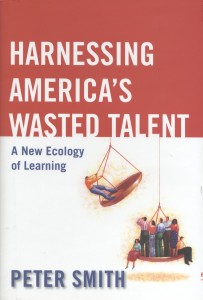 Harnessing America's Wasted Talent: A New Ecology of Learning, Peter Smith, Jossey-Bass, San Francisco, 2010
In 1970, I was a high school student in a suburban New England town. The invasion of Cambodia and the shootings at Kent State had brought spectacular illumination to the end of the academic year and dimmed hopes that the war in Vietnam would soon be over. But optimism and idealism left over from the 1960s still percolated in our midst. That summer, a group of students, aided by a few like-minded parents and educators, came up with the idea of setting up a “free school” in town over the vacation period. Free schools, which at the time were springing up in cities and college towns across the country, were intended to be places where education would finally be democratized; teachers and students would be equals, and the focus would be on real learning rather than meeting pre-established academic standards or simply earning credits. Thanks to several thousand dollars in start-up funding, provided with some reluctance by the school committee, our free school began and flourished, albeit only for an eight-week run, during which we had free use of parts of the high school. It attracted people who had knowledge to share and people, young and old, who wanted to learn. Courses ranged from radio electronics and cooking to rock climbing, foreign languages and simulation games.
Sadly, our free school never managed a second act. By the following summer, idealism had turned to cynicism and the first signs of the decade's economic malaise had begun to make officials more parsimonious and everyone perhaps less experimental. However, having witnessed this wondrous phenomenon, I never entirely let go of the idea that education could be done differently.
Peter Smith, the author of Harnessing America's Wasted Talent, also has had occasion to see education from different vantage points, thanks to a long and varied career in education and politics. Founding president of Community College of Vermont and California State University at Monterey Bay, Smith has also served as Vermont's lieutenant governor and as a Vermont congressman. In recent years, he has authored a slew of books serving up thoughtful critiques of American higher education along with nostrums rooted in his experience.
On a perhaps more controversial note, Smith currently serves as vice president of academic strategies and development at Kaplan University, one of more than a dozen for-profit institutions skewered by investigators of the Government Accountability Office for allegedly deceptive statements made to investigators pretending to be applicants. And for the most part, for-profits are anathema to mainstream educators.
Leaving aside any temptation to shoot the messenger, though, Smith's arguments come across as both persuasive and simple without being simplistic. His central thesis, what he calls his “Law of Thirds” is that higher education has done a generally good job of serving the needs of the “top” one-third of learners who have the means and/or the skills to access and navigate the formal structures of K-12 learning and the college world that follows. However, the remaining two-thirds of learners either never make it out of high school or graduate but do not go on to college. This, he says, is not good enough given that so much job growth is in fields requiring advanced skills.
The cure he proposes is not dismantling higher education, nor does he really fault the higher education “establishment.” Instead, he suggests that higher education is simply “maxed out” and cannot and should not be expected to solve the two-thirds problem by itself. It is what he characterizes as a cottage industry rather than a system—with each school issuing its own currency in the form of academic credits. Still, despite its faults, he is largely content to let much of the higher ed establishment do what it has been doing, often with great success.
What does need to change, he argues, is the notion that only traditional schools, traditional curriculum, traditional classrooms and traditional methods for assessing and awarding credit should remain as the only way to serve up education. Like the American automobile industry, which fattened on cheap petroleum and government subsidized highway and ignored foreign challenges for too long, the education establishment must recognize that change has arrived and a revolution is brewing, Smith writes.
With so many people effectively excluded from the benefits of higher education, with a deep and persistent need for more skilled and capable people in the workforce, and with unlimited quantities of information on the web and communication technologies that have grown ubiquitous and cheap, Smith says America can no longer wait for miracles that will never happen. He points out that the U.S. is the only developed nation where younger workers are less educated than older workers. Therefore, he suggests, educators must devise ways to recognize learning in all its form and engage learners from cradle to grave using more innovative methods and recognizing each individual’s personal learning capabilities.
One of the solutions he proposes is the creation of Colleges of the 21st Century (C21C). Instead of focusing on exclusion—with admission standards as the gate—he says, “For the first time in history, we have the knowledge and the tools available to educate through new designs,” including “emerging information technology.”
C21Cs will, in his vision, thoroughly personalize learning, connecting it to all aspects of life and ensuring the mobility of credit and credentials so no one will be left out of the system. For example, C21Cs would find ways to identify and recognize learning done on the job, in the home and through leisure. The competent and intelligent people that often have crucial positions in our world—albeit without benefit of formal credentials—would be embraced and given opportunities to grow. In the end, he writes, “the new ecology of learning will change forever the balance of power between the learner and his or her learning.”
Smith’s vision of a democratized, wide-ranging and humanized education system is everything an idealist might hope for supplemented by plausible means of implementation that should satisfy the pragmatist. It will be interesting to see how far he gets.
_______________________________________________________________________
Reviewed by Alan R. Earls, a Boston-area writer.
Friday, March 25, 2011
Access, Innovation and “Colleges for the 21st Century”: Interview with Peter Smith
Peter P. Smith, Ed.D. has a history of driving innovation in higher education that few in the field can match. (Full bio at the bottom of this article.) And he hasn’t stuck to one track; he’s the founding President of the Community College of Vermont, former Lieutenant Governor of Vermont , university Dean at George Washington U, Founding President at Cal State at Monterey Bay Assistant Director of UNESCO, and now the Senior Vice President of Academic Strategies and Development for Kaplan Higher Education. In 2010, Jossey-Bass published his latest book: Harnessing America’s Wasted Talent: A New Ecology of Learning (2010). (Makes you feel kinda lazy, doesn’t it?) 
KCH: Your work and writing take up the challenge of helping more students attend and complete college. Other well-known professionals in the field have argued, as I’m sure you are aware, that the problem is not that too few students attend higher education, but too many. Thoughts?
PPS: I have three thoughts about this. First, the people making these arguments went to college and graduated, as did their children and relatives. So, my Vermont puckishness would reply, “If it was good enough for them, it should be good enough for others who have been marginalized”. If they are arguing that we have not gotten it right for previously marginalized learners, they are correct. But to then default to the “no college for you” position ignores the promise of opportunity that America makes to all as well as the history of American higher education. Second, we know definitively that with additional education comes better health, longer lives, increased voting and civic participation, and increased earnings. Those are the outcomes that will create a stronger social, civic, and economic fabric in America. Sounds like a good investment to me. Finally, and importantly, we need more learned/skilled people in America, not fewer. The paramount question facing higher education is how we succeed with previously marginalized people to clear standards of quality.
KCH: You’ve long advocated for recognizing learning that occurs outside of colleges – in the workplace, for example. And you also point out in your book that our colleges no longer have a monopoly on information. Give this state of affairs, should our institutions of higher education migrate toward a focus on the evaluation and validation of learning?
PPS: Absolutely. But as I have ruminated on this subject, and watched the behavior of colleges since I published The Quiet Crisis: How Higher Education is Failing America (Anker, 2004,I have drawn two conclusions. First, most will not do it because their faculty-centric orientation makes faculty teaching and curricular control the focus, not assessment. Second, the few who do will tend to make it a boutique-style program, not a “Best Buy” for higher education assessment. So, it will lack reach. By the time I wrote Harnessing America’s Wasted Talent: A New Ecology of Learning (Jossey-Bass, 2010), I had concluded that we needed new types of institutions in the higher education space, I called them “Colleges for the 21st Century”. And these institutions would operate under a different set of principles and have different characteristics, including comprehensive assessment.
KCH: After dedicating much of your career to the public service within government and state colleges and universities, you’re now at Kaplan University – one of the larger proprietary schools in the U.S. Does the proprietary model offer opportunities for innovation that are not available within non-profit institutions?
PPS: Again, the answer is “absolutely”. One of the main reasons that I chose to work at Kaplan was that I wanted to experience the culture of the “for profit” sector and see if they were any better at embedding and sustaining significant change and continuing innovation. Although businesses are subject to the same realities of organizational culture as any other organization, they are far more focused on the results, student learning and employment. So, employing teaching and learning practices that are known to be best practices characterizes the culture, not the infighting and autonomy that has come to characterize much of traditional higher education’s behavior. Candidly, however, the accelerating pace of change outside of established institutions, including proprietary colleges and universities, will require that this sector be extremely nimble, just to keep up. Whether they will be able to do that, or yield to still other new institutions and programs, remains to be seen.
Author: Keith Hampson
Author: Keith Hampson
Subscribe to:
Posts (Atom)